Posts

Showing posts with the label Curation

Photography and Politics

Image
In the publications  Photography/Politics: One  (1979) and  Photography/Politics: Two  (1986), Jo Spence as part of Photography Workshop sought, through an expansive definition of the titular terms, to address interferences between photography and politics across the history of the medium. Through also focusing on the role of institutions, and particularly as financing entities, the editors and contributors demonstrate the multifarious ways that we are unconsciously subject to the camera’s and photography’s power. While our consciousness of this potential may be comparatively better understood in today’s photographically saturated and occasionally more sceptical cultures, pondering on the revelations of  Photography/Politics  proves nonetheless instructive. For instance, we learn that ways we are presented and present ourselves to the camera are often already determined by internalised modes of seeing, behaving and image-making through our exposure t...
Inspiration in the old

While it's easily acknowledged that history has relevance for the present, and that the work of the past concerning the cultural and artistic productions bequeathed to us still carry value despite and because of their age, it's nonetheless also easily acknowledged that engagement with the past, with that which has gone, is no easy matter. Cue, then, the curatorial turn with exhibitions such as Delacroix and the Rise of Modern Art and Beyond Caravaggio , both at London's National Gallery in 2016. In both we see the desire to demonstrate the relevance to our contemporary sensibilities of 'old names', a necessary abandonment of monographic technical explorations of art, and the excitement to be found in their work. So when I visit Beyond Caravaggio  later this year I expect to see appropriate references to the spontaneity and momentary immediacy of his works--that freeze-frame urgency and vivacity--and the dramatic use of light and shadow, for such references to tec...

Honouring spectator agency / Audience as participants

This is a note on the curatorial impulse and the relevance of curated exhibitions, but first a digression serving to contextualise the educative mission of cultural institutions vis-à-vis the broader learning landscape. Higher education in the UK is receiving more widespread attention at the moment due to last week’s publication of a Government green paper on the proposed Teaching Excellence Framework (TEF). A theme emerging from the discourse surrounding this paper and the implications of implementing the framework and the perceived need for it is talk of consumers and producers. Now this transactional vocabulary is not new – I remember in 2007 hearing a university director and principal talk of the tendency of some students to behave like the customers of universities, and he protested that the relationship between institution, staff and students was not so clear cut – but the use of such vocabulary has become more nuanced. For we also read in these current discussions sur...

Agnes Martin retrospective @ Tate Modern, 2015 - Introduction to a response

What’s the effect of curating a show by an artist of such rarefied means? Does it simplify the exercise, because painting is all she’s got (the odd sculptural object besides)? Does it raise new challenges, because, formally speaking, most of her canvases are all of a type (the early biomorphic abstractions and pre-grid works besides)? How do you engage a broad and varied audience within such parameters, and with an artist who was so (a) abstract (‘there’s nothing to see’), (b) minimalist (‘did she do anything different?’), and (c) expressive (an absence of narrative is cause for anxiety, I might argue, in today’s rationally inclined climate, so sceptical of articulations of sensibility and emotional response). These are some of the questions that come to mind as I sit to write my first blog piece on the Agnes Martin retrospective, which I visited perhaps ten times or more over the course of this summer. I was ineluctably and automatically affected by the works on display—and perhaps ...

The Fallen Woman @ The Foundling Gallery, London

Image
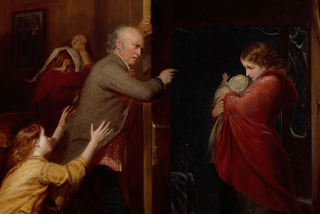
Intended as a corrective to the view of the ‘fallen woman’, this exhibition charts the emergence and development of that idea over the course of the seventeenth to twentieth centuries through a display of museum effects - mainly archival - and supporting artistic media. As an enticement to the largely social-historical narrative the exhibition presents, several canvases ease the spectator in, showing him first of all the productive importance of renewing one’s understanding of an artwork’s subtext, for while the first painting on the left-hand wall shows an interior family scene of parents with their children, the introductory blurbs helps us to see it as an encapsulation of the ideal. In other words, we are not witness only to the fact of nineteenth-century family life, but to the attitude that such a picture of family life was the proper aspiration of any spectator: one was supposed to want to live like that.  Clearly middle class, a painting several along shows a woman playing...

Curating outside @ Louisiana Museum of Modern Art, Humlebæk, Denmark

Awesome tranquillity pervaded my experience of the sculpture park at Louisiana Museum of Modern Art, set on the coast of the Øresund in northern Zealand with views of Sweden just over the narrow stretch of water and the comfort of the museum's modernist embrace behind. Pieces by Moore, Arp, Miró and a host of others snatched my attention and breath as I trod soft thick grass and asked myself unconsciously which ways to turn and explore. This tranquillity was a singular experience, musing on which I have been inspired to think some more about curating and the purpose of an art museum. With the rise of the modern museology over recent decades refracting the view of our historical and artistic expository institutions, I am struck particularly by how much the contemporary museum is supposed to serve as a multimodal space to fit a host of purposes and reflect the diverse interests and motivations of current and potential audiences. What Louisiana showed me, however, is that--properl...

Painting After Performance @ Tate

We always perceive the infinitude of a moment, but we cannot capture it, which made this exhibition seem appetising. Naturally, to say this contradicts some important thinking on perception -- the name Merleau-Ponty looms forth -- and so what I mean exceeds the literal. Being present for a moment, part of its simultaneity, is partially to absorb it and to experience its energy or presentness: this is to be present to the moment in its infinitude, not to apprehend the impossible totality of it. Infinite is infinite. This exhibition claims to explore this complex between the presentness of a performed moment and its representation. And so, when we look at the David Hockney , the jarring of stillness and action creates the overall energy of the piece. The instant after the dive is artistically (gesturally, figuratively) captured upon the canvas. This painting of an action after the performance of it aligns perfectly with the ethos of the exhibition, and, of course,  A Bigger Splash ...

Curating The Ladder of Escape [Addendum]

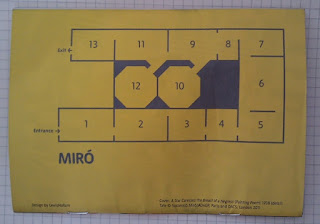
My judgment of the Miró exhibition's curation was hasty.  Blogs are so much about producing something coherent and concise quickly that although I didn't publish the entry until the late afternoon after seeing The Ladder of Escape , that still hadn't been enough time for my ideas to form.  It was while I was preparing the entry for a response to 'The White Cube and Beyond' article in this season's edition of Tate Etc. that I appreciated the curators' positioning of Morning Object , Still Life with Old Shoe and the 50 lithographs of the Barcelona Series. "What we should not forget is that the main focus of today's curators is on the combination of objects in different media.  The field of interest has become so much bigger and more complex, and curators already have enough work on their hands simply showing us things we would not otherwise see" (Thomas Demand in Tate Etc. (21) , p. 85). So, for all my initial scepticism about the layout o...

Museums, what are they?

Image
I'm formulating a response to Niklas Maak, Charlotte Klonk and Thomas Demand's 'The White Cube and Beyond' in Tate Etc. (Issue 21, Spring 2011, pages 78-91), that I'll post soon.  For the moment here's a video adaptation of some of the perspectives expressed in the article, which makes for good introductory reading to the history of the use of museum space.

Classifications

Definitions are notoriously slippery, yet for at least two particular reasons they're helpful.  First, clarifying a position allows people to determine their understanding of it from which they can better contribute to the discussion, or leave it.  And second, their notorious slipperiness make definitions a prime starting-ground for critical debate.  What is a museum? It's clear from my Miró post that in my estimation the Tate Modern is a museum, but before I started this blog I'd always referred to it as a gallery and in conversation I still would.  Efficiency makes me call it a museum.  Since the blog is about museum practice, or museology - the business of collecting, storing, and interpreting material culture for enjoyment and edification in the present and analysis and wonder in the future - if I were to call the Tate specifically a gallery, some might ask where its place in the blog was.  In the broad understanding of the term, the Tate is a museum ...

Joan Miró: The Ladder of Escape @ Tate [Visit 1]

Image
Visiting this made this morning utterly worthwhile and immeasurably inspiring.  It's exhausting, unnervingly despondent at points and, for all that, happily provocative.  I was accompanied by my best friend, some of whose commentary I'll include in this entry for its trenchant observations.  Arriving early meant we were among the first crush to enter the galleries, but that was no surprise given the breadth of publicity that has been spinning around The Ladder of Escape .  I took some notes, thought a lot, chattered a little, and lamented at not being able to take photographs or make a video.  This aside, I was there, and here is what I have to say about it; I'll use the three questions I've mentioned in earlier posts to structure the entry. Curation + Implied narrative/s There are over 160 pieces in the 13 galleries making up The Ladder of Escape which include painting, drawing and sculpture; an array of supports across canvas, velours paper, Masonite an...

Why like that? Miró @ Tate

This blog, ideally, should explore the culture of museology.  That's why I'm focusing on the staging of the Miró exhibition, because it will help me to understand the use of space for the showing of art.  The three questions I've chosen to ask of the exhibition go some way towards starting this in a more structured way.  This is what I suppose I want to get at with the first question What narrative or narratives does the show's curation seem to imply?   Have the curators tried to construct a single exhibition story, or a series of stories?  Whatever answers emerge from this will help to assess the extent to which the exhibition is a learning experience .  That interaction between the art in the space and the story or stories the show organisers intended causes a learning event since it is where spectators develop knowledge.  The final question, How does the staging of Miró here compare with the staging of Cy Twombly: Cycles and Seasons ? encourages f...