Posts

Showing posts with the label Museum

Theory and the Museum

Roxanne L. Euben’s   Journeys to the Other Shore: Muslim and Western Travelers in Search of Knowledge  changed how I read and taught.[1] Drawing on the etymology of ‘theory’, which relates to contemplation, speculation ( theōria ) and ultimately spectatorship ( theōros ), another semantic parallel between Arabic and Greek struck me, since the Arabic,   naẓariyya , likewise connects with notions of looking and speculation. That we often read and speak of theories as ‘lenses’ is appropriate, then, and here I’d like to reflect on the place of theory in museological practices and the ways that the metaphor of theory-as-seeing could be recast. How far do theories inform how curators stage exhibitions and what place do they have for visitors? Considering the catalogues for the National Gallery’s  Michelangelo and Sebastiano , the Tate Modern’s  Agnes Martin  and the Philadelphia Museum of Art’s  Cy Twombly:  Fifty Days at Iliam , they present and b...
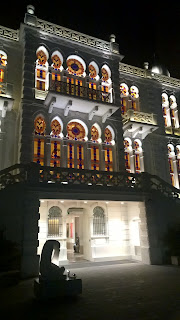
Architecture as preparation: Approaching two museums

Image

Curating outside @ Louisiana Museum of Modern Art, Humlebæk, Denmark

Awesome tranquillity pervaded my experience of the sculpture park at Louisiana Museum of Modern Art, set on the coast of the Øresund in northern Zealand with views of Sweden just over the narrow stretch of water and the comfort of the museum's modernist embrace behind. Pieces by Moore, Arp, Miró and a host of others snatched my attention and breath as I trod soft thick grass and asked myself unconsciously which ways to turn and explore. This tranquillity was a singular experience, musing on which I have been inspired to think some more about curating and the purpose of an art museum. With the rise of the modern museology over recent decades refracting the view of our historical and artistic expository institutions, I am struck particularly by how much the contemporary museum is supposed to serve as a multimodal space to fit a host of purposes and reflect the diverse interests and motivations of current and potential audiences. What Louisiana showed me, however, is that--properl...

Classifications

Definitions are notoriously slippery, yet for at least two particular reasons they're helpful.  First, clarifying a position allows people to determine their understanding of it from which they can better contribute to the discussion, or leave it.  And second, their notorious slipperiness make definitions a prime starting-ground for critical debate.  What is a museum? It's clear from my Miró post that in my estimation the Tate Modern is a museum, but before I started this blog I'd always referred to it as a gallery and in conversation I still would.  Efficiency makes me call it a museum.  Since the blog is about museum practice, or museology - the business of collecting, storing, and interpreting material culture for enjoyment and edification in the present and analysis and wonder in the future - if I were to call the Tate specifically a gallery, some might ask where its place in the blog was.  In the broad understanding of the term, the Tate is a museum ...

Making sense

In my eagerness to start this blog I realise that the first posts (of images taken at Bowes Museum, Barnard Castle) might seem just to hang aimlessly in the blogosphere.  Admittedly, this is part of my project: to allow the images and posts to form whatever story anyone choosing to view them makes.  However, as I'd like not to exclude anyone from the museums, galleries, archives, museology, and curatorship debate, I hope that this entry makes sense of what I've done so far, and of how at this early stage I see the blog developing. There is a folder of images that I'm working with at the moment to include in a post about curatorial space.  This will also refer to earlier posts to start a discussion about the various methods used to display the Bowes' collections from which I'll be able to speculate about how space affects visitor reception and interaction with the museum.  Of course this isn't a new debate, but it is one of the most important that the curator f...