Posts

Showing posts with the label Miró

Context

Before visiting the Agnes Martin retrospective at Tate Modern last weekend I waited for my companion in the bookshop, seduced as usual by the fascinating titles currently available in the art book market. The catalogue for an exhibition at the Viennese Albertina last year on the subject of Miró: From Earth to Sky seized my attention, so I leafed through it momentarily to take a measure of its thinking and a look at the plates; the thought of context was summoned to mind by the beginning of one essay discussing how the surrealist's personal geography played a central part in his making. In turn this gave rise to a memory of his Head of a Catalan Peasant (1925), apparently such an important motif in Miró's work which had first been brought to my knowledge at the Tate's 2011 exhibition Joan Miró: The Ladder of Escape, later reprised in 2012 at the Washington National Gallery of Art . Accidental reading, chance thinking, a particular context reminding me of the notion of contex...
Curating outside @ Louisiana Museum of Modern Art, Humlebæk, Denmark

Awesome tranquillity pervaded my experience of the sculpture park at Louisiana Museum of Modern Art, set on the coast of the Øresund in northern Zealand with views of Sweden just over the narrow stretch of water and the comfort of the museum's modernist embrace behind. Pieces by Moore, Arp, Miró and a host of others snatched my attention and breath as I trod soft thick grass and asked myself unconsciously which ways to turn and explore. This tranquillity was a singular experience, musing on which I have been inspired to think some more about curating and the purpose of an art museum. With the rise of the modern museology over recent decades refracting the view of our historical and artistic expository institutions, I am struck particularly by how much the contemporary museum is supposed to serve as a multimodal space to fit a host of purposes and reflect the diverse interests and motivations of current and potential audiences. What Louisiana showed me, however, is that--properl...

Auto-Impression: Miró @ Tate Modern, The Ladder of Escape [Visit 2]

Writing without a brief is liberating, but I wonder if it's not also indulgent.  By 'Auto-Impression' I meant a sketch of my reactions to the Ladder of Escape , seeing it a second time round.  But the value of that is questionable: if I want readers to derive something other than my opinions from this blog, it has to be my opinions framed within intentions .  To this end, I shall write about the growing sense of liberation one can discern in the Miró exhibition's paintings. The precision of the architectural depiction in Mont-roig, the Church and the Village and The Farm became startlingly apparent to me today.  Having woken up to this, I think I started to find Miró's attention to detail and meticulousness more prominent, especially with regard to the Constellations series, but the pastel drawings and 'neons' on copper are also treated with an artistic exactitude of some force.  If one considers The Ladder of Escape (1940), the way the figures' eye...

Curating The Ladder of Escape [Addendum]

My judgment of the Miró exhibition's curation was hasty.  Blogs are so much about producing something coherent and concise quickly that although I didn't publish the entry until the late afternoon after seeing The Ladder of Escape , that still hadn't been enough time for my ideas to form.  It was while I was preparing the entry for a response to 'The White Cube and Beyond' article in this season's edition of Tate Etc. that I appreciated the curators' positioning of Morning Object , Still Life with Old Shoe and the 50 lithographs of the Barcelona Series. "What we should not forget is that the main focus of today's curators is on the combination of objects in different media.  The field of interest has become so much bigger and more complex, and curators already have enough work on their hands simply showing us things we would not otherwise see" (Thomas Demand in Tate Etc. (21) , p. 85). So, for all my initial scepticism about the layout o...

Joan Miró: The Ladder of Escape @ Tate [Visit 1]

Image
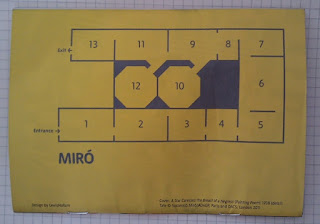
Visiting this made this morning utterly worthwhile and immeasurably inspiring.  It's exhausting, unnervingly despondent at points and, for all that, happily provocative.  I was accompanied by my best friend, some of whose commentary I'll include in this entry for its trenchant observations.  Arriving early meant we were among the first crush to enter the galleries, but that was no surprise given the breadth of publicity that has been spinning around The Ladder of Escape .  I took some notes, thought a lot, chattered a little, and lamented at not being able to take photographs or make a video.  This aside, I was there, and here is what I have to say about it; I'll use the three questions I've mentioned in earlier posts to structure the entry. Curation + Implied narrative/s There are over 160 pieces in the 13 galleries making up The Ladder of Escape which include painting, drawing and sculpture; an array of supports across canvas, velours paper, Masonite an...

Why like that? Miró @ Tate

This blog, ideally, should explore the culture of museology.  That's why I'm focusing on the staging of the Miró exhibition, because it will help me to understand the use of space for the showing of art.  The three questions I've chosen to ask of the exhibition go some way towards starting this in a more structured way.  This is what I suppose I want to get at with the first question What narrative or narratives does the show's curation seem to imply?   Have the curators tried to construct a single exhibition story, or a series of stories?  Whatever answers emerge from this will help to assess the extent to which the exhibition is a learning experience .  That interaction between the art in the space and the story or stories the show organisers intended causes a learning event since it is where spectators develop knowledge.  The final question, How does the staging of Miró here compare with the staging of Cy Twombly: Cycles and Seasons ? encourages f...

Getting ready for Joan Miró: The Ladder of Escape @ Tate

There are only two days until Joan Miró: The Ladder of Escape opens at Tate Modern, so I thought that I should put together an entry to help me understand how I'm going to approach the exhibition and write about it.  Miró first came to my attention in my teens, when I remember buying a print of Blue II (1961) that I subsequently had framed and hung in my room along with Matisse's Creole Dancer (1950).  His oeuvre was certainly formative in my 'awakening to art', as it were, which makes the Tate's "first major retrospective of [his] work in London in nearly 50 years" an exciting destination.  Now that I've started this blog, however, the importance of visiting has redoubled: I'd like to use the experience to learn how the curators staged the exhibition and then to speculate on the use of museum space as a learning environment for art. The roughly 150 art works on display will include drawing, prints and sculptures alongside paintings, which from ...